

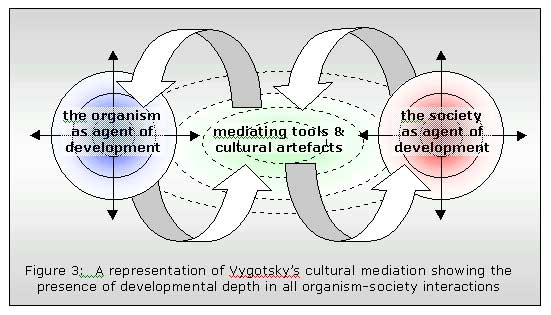
- vygotsky, a Russian Psychologist, is responsible for the concept of "the zone of proximal development"
- the Zone of proximal development is:
- the gap between a learners development level and their potenital learning development
- learners development is determined by social interaction, and collaborative problem solving
- its intresting to note that vygotsky and piaget approached development differently
- while piaget says that you will eventually reach the final stage of cognitive development, vygotsky (as he relies heavily on social interaction) states that infact you may not reach the highest level of cognitive development if you do not have different socaial encouters- GOOD and Bad.
- he felt development was a process that should be analysed rather than an object to be obtained
- although Piaget was correct in staing there are stages Vygotsky felt that because development continues throughout life it was to complex to be defined by stages....this is intresting because i agree with Vygotsky. i cant see how our development it put in stages with AGES when there could be factors that impeed on our development.
- also he feels that is there is no social interaction there is little or no development going to occour
thought and speech:
- when speaking in terms of egocentrism is appears to be a big part of Piagets pre-operational stage. Piaget feels that this is only a characteristics of this stage and that once a students enters into the concrete operational stage egocentrism will dissapear...Just disapear i dont agree with this especially when the preoperational stagehas an age to go with it. egocentrism is important to the development of the student as it will help them understand how others function.
- in comparrison Vygotsky feels that "egocentrism" is purposeful to the development of the student
- egocentric speech helps transisionalise social speech to internalised thoughts.
- he felt that neither thought nor language could not exsist without the other.
- his most important contribution was that thought and speech establishes a link between speech and the development of mental concepts and cognitive awareness (metacognition-thinking about thinking!!!!)
- It should be noted that Vygotsky described inner speech as being qualitatively different than normal (external) speech.
- Although Vygotsky believed inner speech to develop from external speech via a gradual process of internalization, with younger children only really able to "think out loud", he claimed that in its mature form it would be unintelligible to anyone except the thinker and would not resemble spoken language as we know it (in particular, being greatly compressed). Hence, thought itself develops socially.
- The infant learns the meaning of signs through interaction with her mother. She learns that pointing can be a tool and that pointing can be accompanied by cries and gurgles to express what she wants. Through this activity with her caregivers she learns that sounds are signs with which to conduct social interaction and soon the child begins to ask for the names of objects.
- Language starts as a tool external to the child used for social interaction.
- Around the time the child starts school, her self-talk is no longer present, not because it has disappeared but rather because speaking has been appropriated and internalized. Self-talk "develops along a rising not a declining, curve; it goes through an evolution, not an involution. In the end, it becomes inner speech” (Vygotsky, 1987). Inner speech develops through its differentiation from social speech.
i feel Vygtsky is more realistic with his apporach to cognitive development. Piaget may have come up with the stages and i agree with them..having witnessed children develop through them but Vygotsky seems more understandable that children develop MORE with social interaction. hermets are very good at connecting chances are they have suffered a non normative experience whilst developing in their cognitive stages and this has afflicted their development.
http://en.wikipedia.org/wiki/Lev_Vygotsky


No comments:
Post a Comment