Tuesday, February 27, 2007

boss and lead teaching

A Boss Manager vs A Lead Manager
by Dr. Bradley H. Greene
Senior Faculty Instructor
A Boss Manager

1. Judges others
2. Blames people for problems
3. Says, “I am not as bad as a lot of other people”
4. Controls
5. Takes himself and others for granted
6. Covers up mistakes
7. Says, “I only work here”
8. Demands
9. Builds walls
10. Drives his people
11. Depends on authority
12. Inspires fear
13. Says, “I”
14. Gets there on time
15. Fixes blame for the breakdown
16. Knows how it is done
17. Says, “Go”
18. Uses people
19. Sees today
20. Commands
21. Never has enough time
22. Is concerned with things
23. Treats the symptoms
24. Lets his people know where he stands
25. Does things right
26. Works hard to produce
27. Creates fear
28. Takes the credit
29. Seeks first to be understood
30. Has a win-lose approach to situations
a lead teacher:

1. Accepts others
2. Looks for solutions
3. Says, “I am good but not as good as I can be”
4. Admits mistakes
5. Appreciates himself and others
6. Admits mistakes
7. Does more than his job
8. Asks
9. Builds communication
10. Coaches his people
11. Depends on cooperation
12. Inspires enthusiasm
13. Says,“We”
14. Gets there ahead of time
15. Fixes the breakdown
16. Shows how it is done
17. Says, “Let’s Go”
18. Develops people
19. Looks at today and the future
20. Models
21. Makes time for things that count
22. Is concerned with people
23. Identifies and treats the causes
24. Lets his people know where they stand
25. Does the right thing
26. Works hard to get his people to produce
27. Creates confidence in others
28. Gives the credit to others
29. Seeks first to understand
30. Has a win-win approach to situations

http://www.wglasser.com/whatislm.htm

critical reflection of digital immigrants and natives

Critical reflection on higher order thinking:

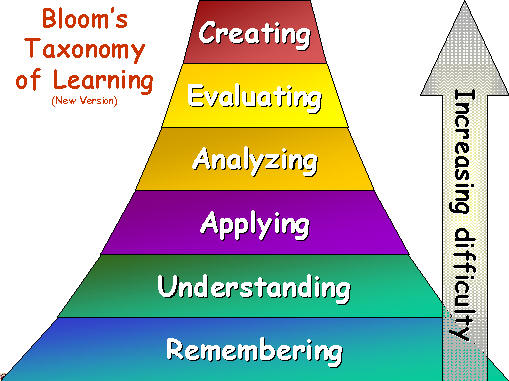
Information is readily avalible to students today. As digital natives it is easy for them to access this information. However they mjust be able to understand this information not just be able to retrive it. Blooms taxonomy

Digital native: a person who has been born into the digital world. They have grown up with computers, television, and the internet. They are aware of the technology lingo needed in a world full of technology.

Digital immigrants: people who were not born into the digital world but have since adapted to the change.


We are not all the same. People in the same age groups differ when it comes to the use of technology.

Access:it is vital that

Diversity- you always have diversity in groups. You will always have some students who are great using technology, and some who feel intimidated by it. It is important to accomadate for this.

Expectations of generation Y:
Members of generation Y expect their employers/TEACHERS to:
provide challenging work that really matters
be respectful and call fourth respect in return
establish monitoring relationships
create a comfortable low stress work environment
balance the role of boss and team player
allow flexible scheduling
provide ongoing training and learning opportunities
spend time getting to know staff members and their capabilities

blooms taxonomy of learning!!!


Monday, February 26, 2007

PIAGET- a lowdown

  • Piaget is the pioneer of the "constructivist theory" of learning.
  • piaget is best known for reorganising the Cognitive theory onto a series of stages.
  • there four developmental stages of cognitive development are:
  1. sensorimotor stage: birth to 2 years
  2. preoperational stage: 2 to 7 years
  3. concrete operational: 7 to 11
  4. formal operational: after 11 years.
  • the theory posits that within the domain of knowledge, the stages usually occur in the same chronological order.
  • however on re thinking Piaget it is important to note that it is the stage not the age that is important in your students certaintily by the time a student reaches High school they should be working in the formal operational stage ( according to Piaget) but experiences of trauma (non-normative experiences) may have effected the cognitive development in your students.
  • this is not to say that your year 8 students will be thinking like infants but rather something has effected them when they were in these stages and therefore hinderd their further cognitive development.
  • a quote from Piaget:

"During the earliest stages of thought, accommodation remains on the surface of physical as well as social experience. " Jean Piaget.

Piaget's view of the child's mind
Piaget saw children as little people creating and building their own world and adding to their knowledge.

people used Piaget's theory to find out what children did not know however Piaget used this to discover children's cognitive development

The developmental process
there was no certain "process" Piaget however described it as a "cycle"
The child performs an action which has an effect on or organizes objects, and the child is able to note the characteristics of the action and its effects.

once children develop new kinds of knowledge, they start to create more complex ideas and complex actions. this enables them to recognise complexities in patterns and constructions.


Piaget feels that this process is not "wholly gradual". when new effective levels of organisation, knowledge begins it will start ti be generalised into other areas. therefore transitions through stages becomes rapid, and much more time is spent refining the new cognitive level.

a "Gesalt" is a term used to define the moment when knowledge that has been gained at one stage of experience leads rapidly to a higher level of insight.


vygotsky


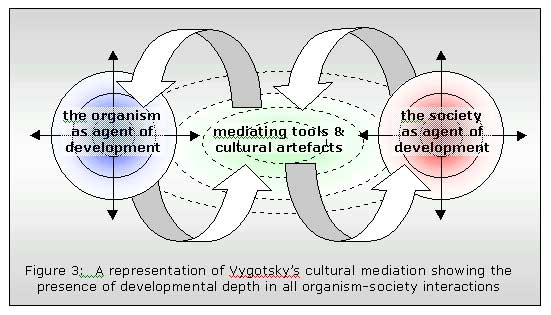
  • vygotsky, a Russian Psychologist, is responsible for the concept of "the zone of proximal development"
  • the Zone of proximal development is:
  • the gap between a learners development level and their potenital learning development
  • learners development is determined by social interaction, and collaborative problem solving
  • its intresting to note that vygotsky and piaget approached development differently
  • while piaget says that you will eventually reach the final stage of cognitive development, vygotsky (as he relies heavily on social interaction) states that infact you may not reach the highest level of cognitive development if you do not have different socaial encouters- GOOD and Bad.
  • he felt development was a process that should be analysed rather than an object to be obtained
  • although Piaget was correct in staing there are stages Vygotsky felt that because development continues throughout life it was to complex to be defined by stages....this is intresting because i agree with Vygotsky. i cant see how our development it put in stages with AGES when there could be factors that impeed on our development.
  • also he feels that is there is no social interaction there is little or no development going to occour

thought and speech:

  • when speaking in terms of egocentrism is appears to be a big part of Piagets pre-operational stage. Piaget feels that this is only a characteristics of this stage and that once a students enters into the concrete operational stage egocentrism will dissapear...Just disapear i dont agree with this especially when the preoperational stagehas an age to go with it. egocentrism is important to the development of the student as it will help them understand how others function.
  • in comparrison Vygotsky feels that "egocentrism" is purposeful to the development of the student
  • egocentric speech helps transisionalise social speech to internalised thoughts.
  • he felt that neither thought nor language could not exsist without the other.
  • his most important contribution was that thought and speech establishes a link between speech and the development of mental concepts and cognitive awareness (metacognition-thinking about thinking!!!!)

  • It should be noted that Vygotsky described inner speech as being qualitatively different than normal (external) speech.


  • Although Vygotsky believed inner speech to develop from external speech via a gradual process of internalization, with younger children only really able to "think out loud", he claimed that in its mature form it would be unintelligible to anyone except the thinker and would not resemble spoken language as we know it (in particular, being greatly compressed). Hence, thought itself develops socially.


  • The infant learns the meaning of signs through interaction with her mother. She learns that pointing can be a tool and that pointing can be accompanied by cries and gurgles to express what she wants. Through this activity with her caregivers she learns that sounds are signs with which to conduct social interaction and soon the child begins to ask for the names of objects.


  • Language starts as a tool external to the child used for social interaction.


  • Around the time the child starts school, her self-talk is no longer present, not because it has disappeared but rather because speaking has been appropriated and internalized. Self-talk "develops along a rising not a declining, curve; it goes through an evolution, not an involution. In the end, it becomes inner speech” (Vygotsky, 1987). Inner speech develops through its differentiation from social speech.

i feel Vygtsky is more realistic with his apporach to cognitive development. Piaget may have come up with the stages and i agree with them..having witnessed children develop through them but Vygotsky seems more understandable that children develop MORE with social interaction. hermets are very good at connecting chances are they have suffered a non normative experience whilst developing in their cognitive stages and this has afflicted their development.


http://en.wikipedia.org/wiki/Lev_Vygotsky


Glasser:


according to Glasser, our behaviours are dependant on five genetically driven needs. these are as follows


  1. survival

  2. power

  3. belonging

  4. fun

  5. freedom

glassers choice theory:

  • developed a cause and effect theory that explains human behaviour!
  • he states that all we do is behave, that all our behaviours are chosen and they are chosen to satisy our 5 basic genetically driven needs!
  • relationships are most important as connecting with people helps us feel like we belong
  • being disconnected is almost always the reason for human problems, people will behave in order to correct this
  • misbehaviour is almost always occours because one of Glasser's 5 basic needs is NOT being met.
  • we can only control our behaviour....not anyone else's
  • all pshycological problems are caused by relationship defincies
  • the only way to satisfy our needs is to satisfy our qaulity world
  • all behviour is TOTAL behaviour consisting of: acting, thinking, feeling and psysiology. of these we can only control acting and thinking, with feeling and psysiology being dependant on those

The term choice theory is the work of Dr. William Glasser, MD, author of the book so named, and is the culmination of some 50 years of theory and practice in psychology and counseling. Choice theory is also a discipline of analyzing the mathematical nature of the choice behavior of economic agents in microeconomics. For choice theory in economics, see rational choice theory.


http://en.wikipedia.org/wiki/Choice_Theory

Hattie-what motivates people to learn??


Feedback :


  • Hattie has made clear that ‘feedback’ includes telling students what they have done well (positive reinforcement), and what they need to do to improve(corrective work, targets etc), .

  • As well as feedback on the task Hattie believes that students can get feedback on the processes they have used to complete the task, and on their ability to self-regulate their own learning.

  • All these have the capacity to increase achievement.

  • it is important that feedback is informative

peer tutoring:


  • this is where the students teach each other. this is an important area for students, as not only do they learn from the peer but the studnet helping them is reinforceing twhat they know...without them realising it!!!!

behavioural objectives:


  • Having and using objectives in the form: “The students should be able to…” immediately followed by an observable verb. For example ‘explain’ is okay because you can listen to, or read the student’s explanation.

  • However ‘understand’ isn’t bevavioural because you can’t see or read the understanding.


http://www.teacherstoolbox.co.uk/downloads/managers/GeoffonHattie.doc